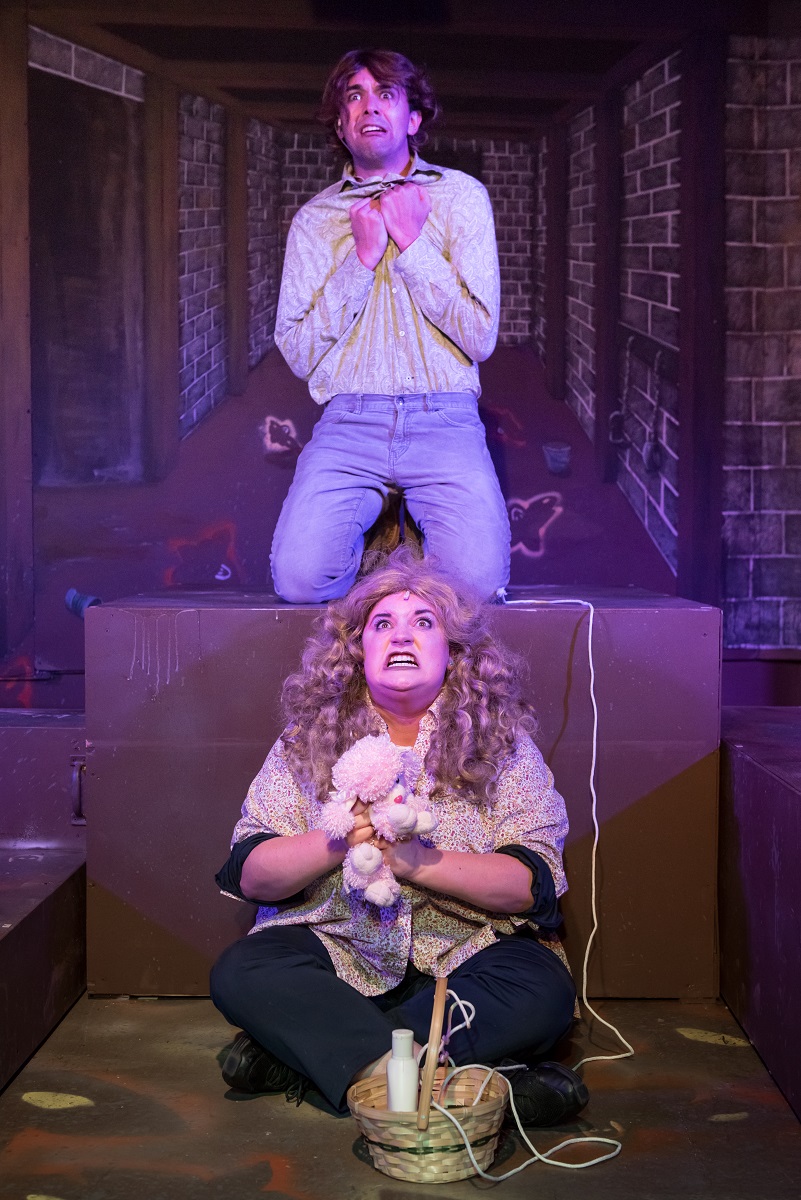
Showing posts with label Blank Canvas Theatre. Show all posts

Saturday, August 24, 2019

“Lobby Hero” at Blank Canvas asks, “What is the moral thing to do?”


Kenneth Lonergan is noted for writing about decent people who are unexpectedly challenged by issues of ethics.  In his “Lobby Hero,” now on stage at Blank Canvas, the 2016 Oscar winner for “Manchester by the Sea” specifically asks, “What happens when emotions come in conflict with principles.”

The play premiered Off-Broadway in 2001, closed, and reopened on Broadway shortly after.  A revival launched on Broadway in 2018.

One reviewer said of the Broadway production, "Lobby Hero is a fantastic play but I'd be hard pushed to say why. You can tell it's good because, within about five minutes, any sense you have of being a member of the audience, sitting down and watching a group of actors perform on stage, has vanished.”   I agree!

In “Lobby Hero” we observe as Jeff, (Benjamin Gregg) a young security guard, who was discharged from the Navy because he was using marijuana, working the night shift in a New York apartment building.  Jeff seems rudderless, lives with his brother and sister-in-law, and his big desire is to rent his own place. 

The job is boring.  Jeff spends his time looking at porno magazines, napping and attempting to read books.  His only regular contact is with William (Darius Stubbs), his supervisor, and Bill (James Alexander Rankin), a married New York policeman who regularly visits a prostitute who lives in the building.  One night, Bill is accompanied by Dawn (Kelly Strand), a rookie cop, who Jeff immediately fanaticizes as a potential girl-friend.

A series of incidents causes the plot to unroll. 

William reveals that his brother has broken into a hospital to steal drugs.  He and his friends killed a nurse, the mother of three children, who attempted to thwart the robbery. 

William, a moral man, shares with Jeff that his brother is trying to prove his innocence by claiming he was at the movies with William.  William is not sure whether to be his brother’s fake alibi. 

Dawn reveals that she has beaten a drunk man outside a restaurant when he resists arrest.  She also shares that she is being sexually harassed by Bill. When she finds out that Bill is spending time while on duty, with the prostitute, she threatens to tell the authorities.  Should she?

Jeff, who tends to babble, reveals to Dawn that William has shared with Jeff that he was not at the movie with his brother.  Should Dawn expose Jeff’s secret?

Lonergan’s writing takes us easily along the path of discovering “how good intentions can be undermined by unconscious desires” and asks over and over, “What is the moral thing to do?”

The Blank Canvas production is nicely paced and the characters clearly developed by director Ann McEvoy.

The cast is universally strong, nicely texturing their performances, creating real people, rather than developing caricatures. 

Patrick Ciamacco’s set and cleverly conceived sound designs help develop the production.

CAPSULE JUDGMENT: “Lobby Hero” is a well-conceived script that gets a superior production at Blank Canvas.

“Lobby Hero “runs through September 7, 2019 at Blank Canvas, 1305 West 78th Street, Suite 211, Cleveland.   For tickets and directions go to http://www.blankcanvastheatre.com/

Next up at Blank Canvas, from September 13 & 14, is “The Who’s Tommy,” a benefit concert based on the iconic 1969 rock concept album. It is the story of the pinball-playing, deaf, dumb and blind boy.

Sunday, July 14, 2019

The Toxic Avenger--a slapstick, double entendre farcical delight at Blank Canvas


Blank Canvas has a niche audience.  They love slasher, off-the-wall, ridiculous plotted plays, especially musicals.

The nerdy group that calls this theatre their home away from home, will find “The Toxic Avenger” well within their scope. 

Yeah, this is “The Toxic Avenger,” the rock musical based on Michael Herz and Lloyd Kaufman’s 1984 cult-film about the attempt of a sweet young man to clean up a New Jersey town, with death-filled results.

The musical, written by Joe DiPietro (who was born in Teaneck, New Jersey and was responsible for “Memphis,” “All Shook Up” and “I Love You, You’re Perfect, Now Change”), with music by David Bryan, and lyrics by the same duo, contains songs with titles such as, “Get the Geek,” “Kick Your Ass,” “Thank God She’s Blind” and the ever popular, “Bitch/Slut/Liar/Whore.”  Really!  (Could I make this up?)

If you are not a regular BC attender, before you come to the conclusion that “The Toxic Avenger” is a definite “do not see,” be aware that it’s impossible for anyone with a sense of humor, who likes outrageous slapstick, cross-dressing, soft rock music, and has an affinity for the bizarre, not to enjoy themselves. 

So, what’s all the fun about? 

Once upon a time in Tromaville, New Jersey, there was a corrupt Mayor-lady (who resembles former-Governor Chris Christy in many ways), who with her henchmen (bullies, mobsters and crooked politicians) controlled the city and used it as their personal piggybank, caring little for the environment or the population. 

In the same town was Melvin Ferd the Third, a geeky aspiring scientist, who loves Sarah, the blind librarian.  Melvin wants to clean up the town’s toxic waste dump and also dump the mayor.  For his troubles he is thrown into a vat of sludge and comes out a hulking green monster named “Toxie.” 

Toxie becomes a superhero to many as he fights city hall and sleazy politicians and businessmen whose greed have made the correctly named Tromaville unfit for human inhabitation.   

In the process, the hysteria is flamed by the blind librarian tripping over every pebble and crack, men and women dressing in drag, lots of quick costume changes, and some bad puns.  Also on stage is a singing and dancing nun, water cannons squirting the audience, a splatter zone where audience members get sprayed with water and other substances and, of course, Toxie, running wild.  Oh, and there are some good zingers aimed at POTUS.

Add a wailing, but subtle rock score, several nice ballads, fun attempts at coordinated dancing, extended farce, and lots of slapstick, and you have “The Toxic Avenger.”

Patrick Ciamacco, the one-man crew at Blank Canvas--he directs, designs and builds sets, does special effects, makes the popcorn sold before and at intermission, while personally financing the whole shebang, adds to his chores for this show.  He admirably plays Toxie, the lead role.  The hulking hulk, he of green and molting skin and a hanging eyeball, has a powerful singing voice and great comic timing. 


For this production Ciamacco relinquishes the directorial reigns to Molly Claassen, who does a smash up job keeping the mayhem constantly moving and the creative juices flowing.  It is amazing to see what the BC thespians do with little space, littler money, “chutzpah,” and a lot of imagination. 

Musical Director Rachel Woods generally controls her players so that most of the dialogue and lyrics can be heard.

Noah Hrbek (White Dude) and Sydney Smith (Black Dudette) are a hoot as they change sexual orientations, accents and costumes with ease.  “Hey, waddya tink,” dis is ‘posed to be fun an’ dees two helps-uh-lot.”

Leslie Andrews, she of “zaftig” cleavage, makes the most of her assets (the physical and vocal ones) to create a nasty Mayor Babs.  She also hits the stage as Ma Ferd and the nun.  She even plays two people at once.  Talk about being multi-talented.

Pat Miller is adorable as the love-struck Melvin, a man with a mission to save New Jersey from itself.

Pretty Madeline Krucek stumbles around the stage as the blind Sarah, singing with a fine voice and nicely developing her role.

CAPSULE JUDGEMENT: “The Toxic Avenger” isn’t great theater, but it is lots of fun for those inclined to enjoy the bizarre and are willing to laugh at the slapstick shticks that make this production a wonderful summer escape. 


“The Toxic Avenger “runs through July 25, 2019 at Blank Canvas, 1305 West 78th Street, Suite 211, Cleveland.   For tickets and directions go to http://www.blankcanvastheatre.com/

Next up at Blank Canvas is “Lobby Hero,” which asks what happens when emotions come in conflict with principles.  The script was written by the 2017 Oscar-winning author of “Manchester by The Sea.”

Friday, April 12, 2019

“Art” examines the value of friendship and esthetics @ Blank Canvas


What is art?  What is friendship?  What is the value of a piece of art?  What is the value of friendship?  These are just some of the questions which are put forth in Yasmina Reza’s French-language play that has been translated into English by Christopher Hampton and is now in production at Blank Canvas theater.

Though billed as a comedy, the play, which centers on a long-time friendship between Serge, Marc, and Yvan, burrows more into the realm of drama.

The incident that kicks off the probe into the values of a variety of subjects, both real and emotional, centers on Serge, who has a penchant for modern art, buying a large, expensive, white painting.   Well, depending on the lighting and the viewer’s imagination, white or maybe white on white, or white with white stripes.  Whatever, it’s a $200,000, as Marc states, “Piece of sh*t.”

Often argumentative Marc, who seems to have no “speak what I think or feel” valve, is horrified by Serge being “had” by his desire to be on the ‘in” of the trends, strongly affected by what “they” think.

As a result of the war over white, the friendship suffers a severe strain.  Serge is miffed.  Marc is astounded by Serge’s naïve purchase.   The real issue, however, is below the surface.  The foundation on which their friendship gets unearthed in their arguments, and the end of their connection is near. 

In steps Yvan, a court jester-type friend who has neither the intellectual or debate abilities to spar with the fierce duo.  Why he is even a friend of Marc and Serge becomes an instant question.  He, like many court jesters, plays the role of emotional release.  He babbles on, jokes, naively makes pronouncements.  He’s good for a laugh.

Of course, Yvan, caught in the middle of the conflict, tries to please and mollify both combatants, to no avail.  He rambles on about the problems regarding his upcoming wedding, overacts the effects of whose names are going to appear on the invitations, and acts out his dramatic and angst-filled telephone conversations with his mother.


What’s is the real issue?   Is Marc scornful of the painting, or the uncharacteristic independence of thought that the purchase reveals in Serge? 


For the insecure Yvan, burdened by the problems of his impending doom wedding where he is stuck in an insoluble problem and his dissatisfaction at his job as a stationery salesman, is it anything other than his need for friendship, no matter the cost? 


For Serge, is it his need to be accepted, positively regarded by “them,” the art “aficionados” or his desire to break from the seeming control that Marc holds over him?


“Lines are drawn and they square off over the canvas, using it as an excuse to relentlessly batter one another over various failures. As their arguments become less theoretical and more personal, they border on destroying their friendship.” 


What is the value of art?  What is the value of friendship?


The Blank Canvas production, under the direction of Lara Mielcarek , is a work of art, in and of itself.  The characters are clearly drawn, the pace appropriately rapid, the script adjustment turning the play from a series of short scenes to a ninety-minute one act is effective.


Brian Pedaci properly rages as the powerful, controlling Marc.  He is a bull in an emotional china shop, needing to control, and angst filled when challenged. 


Chris D’Amico, appropriately dressed in a Victor Vasarely op-ed patterned sweater, is totally on track as the insecure Serge, both needing assurance and wanting to make decisions on his own that prove he is more than a friend in need.


Though he over-acts in his long wedding planning monologue, performing more with farce rather than a comedy slant, Michael N Herzog is properly pathetic as Yvan.


CAPSULE JUDGEMENT: “Art” is a fine example of “thinking-persons” theater.  It is the type of script that stays with the viewer a long time after the production encouraging probing into the value of not only art, but friendships and relationships.  Blank Canvas helps the thinking process with a strong production.

“Art” runs through April 20 at Blank Canvas, 1305 West 78th Street, Suite 211, Cleveland.   For tickets and directions go to http://www.blankcanvastheatre.com//

Saturday, March 02, 2019

SPIDER WOMAN weaves intriguing web @ Blank Canvas


Musicals come in different forms.  Musical comedies, such as “Cinderella” and “School of Rock” intend to entertain.  Musical dramas--think “Dear Evan Hansen,” “Come From Away,” and “Hamilton,” relay thoughtful ideas in words, song and dance. The musical tragedy, such as “Sweeney Todd” and “The Kiss Of The Spider Woman,” which is now on stage at Blank Canvas, finds a “victim” in a society which doesn’t understand or appreciate them, resulting in dire consequences.

“Kiss of the Spider Woman,” with music by Oberlin grad, John Kander, and his writing partner, Fred Ebb, the conceivers of “Cabaret” and “Chicago,” is based on Manuel Puig’s novel “El Beso de la Mujer Araña.”  The musical won the 1993 Tony Award for Best Musical.

In “Spider Woman,” Luis Alberto Molina, an Argentinian, has been sentenced to an eight-year jail term for corrupting a minor.  The fey homosexual former window dresser, who has a mother fixation, lives in a fantasy world as a means of escaping the horrors of prison.  His obsession is movies which featured Aurora, a sultry diva, who starred in bigger-than life telenovela soap-opera films of high emotion.  

In one of her movies, Aurora, as a spider woman, kills her lovers with the kiss of death.

Molina has learned to live with the taunting and sexual impositions of the prison guards, but one day his world is rocked when a new prisoner, Valentin, a handsome Marxist political revolutionary, is cast into his cell.

Valentine, who has been severely tortured, is nurtured back to health by Molina.  In order to block out the cries of other tortured prisoners, Molina talks non-stop.  He shares his history, his love of movies, his obsession for Aurora. 

At first the duo clashes. Valentin draws an imaginary line down the middle of the cell with an understanding that Molina will stay on his own side.   Eventually, however, Molina starts to win over Valentin with his story telling and humorous charm. 

Valentine is again severely tortured.

Molina again nurses him back to health.  In a show of faith, Valentin shares information about his personal life and his revolutionary activities.

In an attempt to get Molina to relate the vital information the warden offers to free him so he can go home to his “ill” mother.

The relationship between the cellmates deepens. Molina is forced to make a decision of whether or not to share the evidence that Valentin has secretly shared, while the “kiss of the Spiderwoman” hangs over the lives of the men.

“Kiss of the Spider Woman” is a difficult musical to produce.  It requires two exceptional actors to create the roles of Molina and Valentin. Director Patrick Ciamacco was fortunate enough to find the perfect duo.  

Scott Esposito develops a Molina who gives just the right level of fey, while not going over-the-top.  He is real, accessible, allowing the audience to feel his emotional pain.  He has a fine singing voice, which is beautifully showcased in “She’s a Woman” and “Mama, It’s Me.”  “Only in the Movies” is a showstopper.  His is an exceptional performance.

Michael Snider creates a well-textured macho, yet sensitive, Valentin.  His developing affection toward Molina unfolds in a shroud of reality.  The duo’s affection has an air of authenticity.  His strong vocal talents are showcased in “Over the Wall III” and “The Day After That.”  “Anything for Him,” sung with Esposito and Rachel Maria Ines (Spider Woman/Aurora) was powerful.  The emotional arching between Snider and Esposito was extremely believable, a necessity for the “realness” of the story development.

The male chorus sings exceptionally well.  Their “Morphine Tango” was engaging.  The men’s dancing generally has an air of clumsiness and lack of spontaneity which adds to their macho, rather than chorus boy image.

Rachel Maria Ines does not have the stage dynamics needed for Spider Woman/Aurora.  Though she sings well, and her aerial work is intriguing, she fails to spotlight the firepower to be the subject of Molina’s obsession.

Musical director, Bradley Wyner, needs to rethink some of his musical choices.  Often, such as in “The Day After That,” the singers had to fight with the music to be heard.  In general, the heavy handed keyboard pounding was over-the-top.  The purpose of the music is to support the singers, not drown them out.

Patrick Ciamacco’s metal spider-webbed design is functional and works well to keep the action moving along, as does his precise and nicely-conceived stage movements.

Jenniver Sparano’s costume designs, especially as they relate to Spider Woman/Aurora helps develop the image of the character.

CAPSULE JUDGEMENT: “Kiss of the Spider Woman” is a haunting musical drama which generally gets a fine performance. The stellar performances by Scott Esposito and Michael Snider is a master class in musical theater performance.  It is a production very well worth seeing!

“Kiss of the Spider Woman” runs through March 16, 2019 at Blank Canvas, 1305 West 78th Street, Suite 211, Cleveland.   For tickets and directions go to http://www.blankcanvastheatre.com//

Next up at Blank Canvas is “Art” an examination of the world of art and the resulting conflict between three “friends” who are forced to ask question of not only the nature of painting, but the purpose of friendship.  (April 5-20, 2019)

Monday, December 10, 2018

“Special” “Avenue Q” @ Blank Canvas


It has been said that dying is easy, farce is hard to do!  And, “Avenue Q,” the delightful, satirical, coming of age parable by Robert Lopez and Jeff Marx, is farce at its highest level.

An adult take-off on “Sesame Street,” the catchy tune-filled show, puts a spotlight on porn, issues and anxieties associated with growing up, porn, homosexuality, puppet sex and porn.  Centering on the issue of being a generation that found they were praised for little effort, and being “special” with no need to prove it, the musical not only stars real people, but adult sized puppets, entertaining graphics and puppet nudity.

“Avenue Q,” which won the 2004 Tony Award for Best Musical, Best Book for a Musical and Best Original Score, has a score made up of such fun memorable songs as “Special,” “It Sucks to Be Me,” “If You Were Gay,” ”Everyone’s a Little Bit Racist,” “I’m Not Wearing Underwear Today,” and “For Now.”  (Hey, this is a farce, not “West Side Story.”)

The story centers on Princeton, a recent college graduate, who is anxious to discover his purpose in life.  Reality sets in when he realizes that his degree in English is an open alley to no job skills, has no place to live, and is dependent upon his parents for money. 

His search for a place to live leads him to Avenue Q, in the low rent district, populated by an eccentric group of neighbors, including Kate Monster, an assistant kindergarten teacher; Rod, an up-tight closeted gay Republican banker; Nicky, Rod's slacker roommate; and Trekkie Monster, a recluse who surfs the Internet all day in search of porn.  They all agree that "It Sucks to Be Me.”

With advice from the Bad Idea Bears, Princeton makes some very bad choices, his neighbors attempt to navigate their rudderless lives and, as happens in all good fairy tales, all ends well “For Now.”

“Much of the show's ironic humor emerges from its contrasts with “Sesame Street,” such as illustrating the differences between innocent childhood and difficult adulthood. The storyline pre-supposes the existence of "monsters" and talking animals, and human actors who sing, dance and interact with puppets, both human and non-human in a light-hearted, quasi-fantasy environment.”

The original script was set on a fictional street in an “outer-outer borough” of New York.  The Blank Canvas version takes place in an unidentified neighborhood of Cleveland, allowing for references to the Terminal Tower, the Browns, moving “upscale” to Cleveland Heights, and wearing CLE clothes.

“Avenue Q” is the type of script that Blank Canvas Artistic Director Pat Ciamacco, does so well.  He knows exactly how to guide a cast to develop believable farce, adds humorous “shtick,” engages the audience, and milks laughs while keeping true to the intent and purpose of the author.  He also knows how to design and build marvelous puppets (along with Dave Haaz-Baroque)!

The cast is outstanding.  They not only smoothly operate the adult-sized puppets, but have developed personalities and voices that perfectly fit every character.  Wow!

Huzzahs to Shane Patrick O’Neill, Leah Smith, Scott Esposito, Trey Gilpin, Luke Scattergood, Anna Sylvester, Neda Spears, Brett DiCello, Katie Gucik, David Turner, Becca Ciamacco and Kate Michalski for forming an ensemble cast without a weak link.  They have great singing voices, do choreography with ease, and nicely texture their characterizations.

Matt Dolan and his raucous band have the difficult task of keeping the volume down in the small black box space and generally do it, while effectively rocking away.

The show is aided by smooth transitions from scene to scene, creative choreography (Katie Zarecki), effective lighting (Jeff Lockshine) and clever projections (Ciamacco and Noah Hrbek).


CAPSULE JUDGEMENT: “Avenue Q” is a well-conceived, delightful, must see production that shows how entertaining and purposeful a play can be with the right director and talented cast.  Most performances are sold out, but it’s well worth the effort to try and get a ticket!
“Avenue Q” runs through December 22, 2018, in the Blank Canvas west side theatre, 1305 West 78th Street, Suite 211, Cleveland.   For tickets and directions go to http://www.blankcanvastheatre.com/

Tuesday, February 27, 2018

SWEENEY TODD, Sondheim at his most complicated @ Blank Canvas


Stephen Sondheim, who wrote the music and lyrics for “Sweeney Todd:  The Demon Barber of Fleet Street,” which is now in production at Blank Canvas, is noted as a brilliant lyricist.  Interestingly, that is not the way he sees himself.  He is well-trained as a musical composer, having, from a young age, been the prodigy of Oscar Hammerstein II.  Yes, the composer of such mega hits as “Oklahoma,” “South Pacific” and “Sound of Music.”


Sondheim was in his mid-twenties when he wrote the lyrics for “West Side Story” and “Gypsy.”  He quickly gained a reputation for writing pure rhymes, clever twists on phrases, and character-describing songs that fit perfectly into the plot.
“Sweeney Todd:  The Demon Barber of Fleet Street,” or, as it is better known, “Sweeney Todd” was written in 1979.  Known as a musical thriller, is based on a 1973 play by Christopher Bond and won the Tony Award for Best Musical Play.

The score, probably one of Sondheim’s most complex, is filled with intriguing harmonies and counterpoint.  Because most of the dialogue, about eighty percent, is sung, many consider the piece as an opera.  “Never before or since in his work has Sondheim utilized music in such an exhaustive capacity to further the purposes of the drama.”

The brilliant list of musical numbers includes the beautiful “Johanna,” the delightful “The Worst Pies in London” and the heart wrenching “Not While I’m Around.”

The story, centering on obsession, tells the tale of Sweeney Todd (formerly Benjamin Barker), who was exiled to Australia by Judge Turpin, a ruthless judge who lusted after Todd’s wife.

It is now 1846, many years after the now renamed Sweeney Todd’s exile. 

We meet young Anthony Hope and Todd on a London pier.  Todd has recently rescued Hope at sea and befriended him.  The duo is confronted by a crazed Beggar Woman.   Todd wanders into a meat shop, below his former barber shop, hoping to find out the whereabouts of his wife and daughter. 


Mrs. Lovett, noted as the maker of the worst pies in London, tells about the “death” of his former wife.  She relates that Judge Turpin, who also has taken their daughter, Joanna, as his ward, raped Todd’s wife.  Todd threatens revenge against Turpin and his henchman, Beadle Bamford.  Thus, the plot is laid for a tale of murder and revenge.

Blank Canvas never ceases to amaze.  Performing on a postage-size stage, tucked away on the 2nd floor of the former American Greeting Card warehouse, operating on a shoe-string budget, Artistic Director Patrick Ciamacco and his merry band of performers draw in sold out houses producing off-beat musicals (e.g., “The Wild Party,” “Silence,” “Triassic Parq” and “Reefer Madness “), folded into such classics as “Our Town” and “Of Mice and Men.” The theatre often garners Cleveland Critics Circle and BroadwayWorld-Cleveland awards for excellence.

“Sweeney Todd” is yet another one of those winners.  

Director Jonathan Kronenberger has used every inch of space to keep the well-paced and intense drama moving along to its blood-drenched conclusion. 

Patrick Ciamacco’s scene design works well to enhance the action.  The vocal sounds and music, under the guidance of Matthew Dolan, are well conceived.

Ciamacco, with his strong singing voice and well-textured acting, makes Todd both grief-driven and revengeful.   “Pretty Woman,” a duet with Brian Altman (Turpin) was nicely sung.

Though he lacks the macho leading man presence, Robert Kowalewski is appealing as Anthony Hope.  His rendition of “Johanna” is masterful. 

Trinidad Snider delights as Mrs. Lovett.  Her “Not While I’m Around,” sung with Devin Pfeiffer (Tobias), is emotionally draining, while “A Little Priest” is laugh-inducing.

Lovely Meg Martiniez (Johanna) has a fine singing voice.  The rest of the cast is excellent.
 

CAPSULE JUDGEMENT: “Sweeney Todd” gets a strong and meaningful performance and should please even the most critical of Sondheim aficionados.
 
“Sweeney Todd” runs through March 10, 2018, in the Blank Canvas west side theatre, 1305 West 78th Street, Suite 211, Cleveland.   For tickets and directions go to http://www.blankcanvastheatre.com/

Wednesday, December 06, 2017

URINETOWN, bad title, fun show, flushed with success @ Blank Canvas


 “Urinetown:  The Musical” opened on Broadway in 2001, but its path from lyricist Greg Kotis traveling Europe, encountering a pay toilet, getting an idea for a story, joining with Mark Hollman, writing the lyrics together, Hollman writing the music, previewing the show at the New York’s Fringe Festival, and getting it on Broadway, was filled with pitfalls.  Mainly, producers were turned off by the title. 

Eventually, the Bertolt Brecht-style musical, filled with parodies of Broadway shows, that satirizes capitalism, social irresponsibility, the legal system and populism, found The Araca Group. 

Araca, a New York company is composed of three young men from the west-side of Cleveland.  Brothers Matthew and Michael Rego met Hank Unger during a community theater production of the “Music Man” in 1985, which I directed.  And, in spite of my advice, have gone on to be theatrical wunderkinds.

The trio formed a production company, named it after the Italian town from which “grandpa” Rego (remember Rini-Rego Supermarkets?) came.  The trio had produced “Vagina Monologues” and were looking for their next show.  “Urinetown was it.  They have since produced such Broadway hits as “Wicked,” “’night Mother,” “The 25th Annual Putnam County Spelling Bee,” “Rock of Ages,” and the newly opened hit, “SpongeBob Square Pants.”

The musical opened off-Broadway, then moved on to the Great White Way in September, 2001, to strong positive reviews, gained back the initial investment in a record-breaking six weeks, and closed in early 2004, after 26 previews and 965 performances.  National tours and local performances have followed.

The tale centers on the idea that “In the not-so-distant future, a terrible water shortage and 20-year drought has led to a government ban on private toilets and a proliferation of paid public toilets, owned and operated by a single megalomaniac company: The Urine Good Company.  If the poor don’t obey the strict laws prohibiting free urination, they get sent to the dreaded and mysterious ‘Urinetown.’

After too long under the heel of the malevolent Caldwell B. Cladwell, the poor people stage a revolt led by a brave young hero [Bobby Strong].  They fight for the freedom to pee “wherever you like, whenever you like, for as long as you like, and with whomever you like.”


Sound preposterous?  Were you aware that every November 19, the United Nations sponsors “World Toilet Day,” a day set to raise awareness that 2.4 billion people do not have a toilet to use?  The reasons?  Draught, poverty, and government and business control over the flow of water.

“Urinetown:  The Musical” is fun, but it is more than escapism and catchy tunes.  This is a tale of greed, corruption, love and revolution in a city where water is worth its weight in gold. 

Messages pervade, such as what happens when big business is given the right to control our lives.  Think of the pharmaceutical and medical companies and their stranglehold over our health.  What happens when citizens have their rights taken?  What is it like to be lied to continually in an attempt to push a political and economic agenda?  Think Trump and his motley crew!

Think of the rape of the environment caused by loosening the clean air act, elimination of national monuments, and the attitude of “drill,” “drill” “drill” and “dig, dig, dig,” damn the environment. 


Patrick Ciamacco, Blank Canvas’s Artistic Director, loves farce.  He revels in scripts that are out of the norm.  Give him fake blood, sexual titillation, and social deviance, and he’s all in.  This becomes obvious when you consider that he has produced “Debbie Does Dallas” (incidentally, another Araca show), “The Rocky Horror Show,” “Silence! The Musical,” “Wild Party,” “Reefer Madness,” “Bat Boy,” and “Triassic Parq the Musical.” 


Ciamacco and his staff, as evidenced by the screaming, clapping, raucous opening night audience, have created another winner with “Urinetown.” 


It never ceases to amaze of can be created on the theatre’s postage stamp-sized stage.  How choreographer Katie Zarecki squeezes all those bodies on the platform, yet has them dance in a semblance of order, is a wonder.  


Not only did Ciamacco get the cast in character, make sense of the lines, and get lots of laughs, but he designed the lights and sound and built the sets.  Talk about being “all in.”


He is ably supported by musical director and keyboardist, Matthew Dolan, and his well-tuned band (Aaron T. Phillips, Jason Stebelton, Keith Turner and Marcus Greene).


The cast is strong.  Rob Albrecht as Office Lockstock, the narrator, has a wonderful voice filled with irony and satirical overtones.  Dayshawnda Ash comes close to stealing the show as Little Sally.  Stephanie Harden is believable as Hope Caldwell, the evil Caldwell B. Cladwell’s daughter and girl- friend of our hero, Bobby Strong.  Daryl Kelley could be a little more “boy next door”/ “awe shucks” as Bobby, but he does nicely with his solos.  


The chorus sings and dances with vigor.


CAPSULE JUDGEMENT: “Urinetown:  The Musical” is flushed with success and audiences will enjoy themselves, while gaining some insight into political and economic corruption.  Get tickets early as the Blank Canvas theatre is small and this show should be a big box office success!


“Urinetown:  The Musical” runs through December 16 in the company’s west side theatre, 1305 West 78th Street, Suite 211, Cleveland.   For tickets and directions go to www.blankcanvasthetre.com

Sunday, October 08, 2017

Farcical, slapstick “The Rocky Horror Show” fun at Blank Canvas


On June 20, 1973 I had one of my mind-blowing experiences in a theater.  I was in London, the theater broker couldn’t get a ticket for the show I wanted and offered a ducat for a newly opened show.

I knew nothing about the musical, but, upon arriving at the Royal Court Theatre, I realized that I was in for a wild ride.   Instead of entering the lobby, those with tickets were queued-up, single file.  One-by-one, we were ushered into a blackened auditorium, led by an usher with a narrow-beamed flashlight.  Some of the audience members were given rain ponchos.  He led me down the aisle, pointed to a seat, I sat.

Suddenly a spotlight on stage revealed an usherette who gave a short speech.  Then a spot appeared on a platform raised above the audience at the rear of the theatre and we watched as Brad proposed to Janet.  The duo got into a car, the motor was heard starting, along with deafening thunder.  Lightning flashed and a “roadway” was seen, “rain” started falling, splashing onto the rain-coated people sitting along the runway that ran down the center of the performance space toward the stage.  There was the sound of a tire blowing out, Janet and Brad, with rain falling on them ran down the ramp, the stage became illuminated with more lightning and we were looking at an old scary castle with massive doors.

Yes, I was about to experience the bizarre “The Rocky Horror Show.” 

Yes, that musical.  The phenom which would become the cult movie. 

Yes, the show that introduced the world to Riff Raff, the live-in butler, his sister Magenta, the maid, Eddie, an unlucky delivery boy who fell victim to unfortunate circumstances, Rocky, the super-stud creation of Dr. Frank N. Furter, a pansexual, cross-dressing mad scientist, who plaintively tells us, in song, that he is "a sweet transvestite from Transsexual, Transylvania."   Oh, and “The Time Warp,” the show's signature dance number.

During the ridiculousness, both nerdy Brad and virginal Janet are seduced by Frank "N"Furter, the mystery of aliens is revealed, Rocky turns out to be a sweet monster, Phantoms run wild, and poor Eddie gets mangled by an electric saw (relax, we only see the blood spattering). 

“The Rocky Horror Show” is a musical with music, lyrics and book by Richard O'Brien.   It is a bizarre tribute to the science fiction and horror B movies of the mid-1900s.

The original London, England showing was staged at the Royal Court Theatre (Upstairs) on 19 June 1973, and ran for a total of 2,960 performances.  

The 1975 Broadway debut at the Belasco Theatre was met with terrible reviews and ran only forty-five showings. (Yes, I saw that bomb as well.)

Fortunately (?) it was adapted into the also badly reviewed 1975 film The Rocky Horror Picture Show.  In spite of the reviews, it became a cult hit, with Saturday night midnight showings.  Showings at which customers dress as story characters yelling out lines and follow-ups to the sexually suggestive lines, squirting each other with water during the rain storm and leaping from their seats to dance “The Time Warp.”  (Interested?  The Cedar Lee Theatre on Lee Road in Cleveland Heights has regular showings.)

You have to go into the 90-minute gag-fest with the right attitude.  This is over the top, farcical, slap-stick material presented with over-acting, audience involvement, and no semblance of purpose or message.

As the program states, “when sharing the Rocky experience, the idea is to have fun!’  participants are encouraged to: 
•DRESS UP: Everyone has a right to wear whatever you wish. We encourage you to come dressed as your favorite character or just come casual. It’s up to you!  

•CALLBACKS: Callbacks are encouraged and allowed. They should be used to add to the Rocky experience. Don’t try to shout down other people. They might know better lines than you do!   (A number of brave souls yelled out frequently.)
•THE TIME WARP: You can stand and dance with the cast. Just stay off the stage, please. Doing the “Time Warp” is essential, but it’s easy because they just tell you how to do the dance in the song! You’re set!
•PROPS: You can bring approved props or buy an audience bag at the theater. Some of the standard items are not required for the LIVE version of the show and others just are not allowed in our theater due to safety and cleanup.”

“The Rocky Horror Show” is a perfect script for Patrick Ciamacco, the “curmudgeon-in-charge” (Artistic Director) of Blank Canvas Theatre.  He loves shtick, he revels in slap-stick, he lives for the ridiculous.  He also knows his loyal audience, who have his same tastes, and has told his cast to let loose, and they do. 

Kevin Kelly camps to excess as Frank “N” Furter, Jonathan Kronenberger does a perfect Alfred Hitchcock as the Narrator, Danny Simpson makes us relive the glory days of Peter Loree as Riff Raff, and Amber Revelt is appropriately seductive as the alien Magenta. 

Mark Vandevender, he of gym-toned body, shows off his muscles clothed only in gold lamé short shorts, with a 9-inch appendage hanging out, while Ken-doll, Eric Fancher (Brad) and Gidget-cute, Meg Martinez (Janet) display vocal and acting skills (especially when reaching the heights of their sexual releases) as the star-crossed lovers.

The band (Zach Davis, Jason Stebelton, Keith Turner and Mark Bussinger), under the conducting of Bradley Wyner, gets a little out of hand at times, drowning out the singers, but neither the score nor the lyrics are Tony Award caliber, so the excess doesn’t get in the way.

CAPSULE JUDGMENT:  If you are in the right mood, and can let loose of your inhibitions, and take “The Rocky Horror Show,” for its intended purpose—a screwball musical comedy, you’ll have a blast!  This is not “Next to Normal” or “Bridges of Madison County,” just some” The Time Warp” fun!

Blank Canvas’s “The Rocky Horror Show” runs through October 28, 2017, in its near west side theatre, 1305 West 78th Street, Suite 211, Cleveland.  Get directions to the theatre on the website. Once you arrive at the site, go around the first building to find the entrance and then follow the signs to the second floor acting space.  For tickets and directions go to www.blankcanvastheatre.com

Next up at BC: “Urinetown The Musical” from December 1-16, 2017.

Saturday, August 12, 2017

Superb “Equus” filled with passion at Blank Canvas


In the early 1970s, master wordsmith and playwright Peter Shaffer read a small news story, with little details, about a boy who had blinded six horses at a stable in Sussex, England.  The writer’s imagination went into full gear.  He created a script which included a family background for the obsessed young man, an image of a troubled but successful psychiatrist, and wove them into a compelling play which he named “Equus.”

The story centers on Alan Strong (Antonio DeJesus), a teenager, living in a small town in England and Martin Dysart (Russell B. Kunz), the psychiatrist who treats him after Heather Saloman (Amiee Collier), a compassionate magistrate, pleads with Dysart to take Alan as a patient. 

From the opening scene, in which Alan tenderly hugs Nugget, a horse, to the emotional closing, Shaffer’s two-and-a-half-hour script grabs and holds the viewer’s attention. 

With Dysart as the narrator, we meet Frank (Andrew Narten), Alan’s atheistic, hypercritical father, and Dora (Claudia Esposito), his enabling school teacher mother.  We learn how Jill Mason (Sarah Blubaugh), a young woman introduces him to stable owner Harry Dalton (Chris Bizub) who hires the boy.  We observe as Jill attempts to introduce the virgin boy to sex.  We observe Alan connect to the stable’s horses (Daryl Kelley, Jason Falkofsky, Zac Hudak, Evan Martin, Anthony Salatino and David Turner), who Alan loves, yet is the subject of his maiming.

We observe Alan change from a boy who chants advertising jingles in order to protect himself from human contact, to revealing a little of his past, to finally coming to an understanding of why he acted as he did, with the possibility of his becoming normal.  “Normal.”  Whatever that means.

Alan is not the only one with high angst.  Dysart is in a loveless, sexless marriage, is living an unfulfilled existence, and finds himself having severe nightmares about being a destructive chief priest in Homeric Greece.

The tale is told in retrospect. Dysart, as the narrator, takes the audience to various times and places as fits the tale, rather than making the story sequential.

“Equus” is a tale of passion, religion, sexuality, pain, blame, and freedom.  Alan, a boy in pain, is obsessed with horses from first coming in contact with one on a beach when he was young.  He creates Equus into a Christ-like figure.  Even his first attempt at sex takes place in his “church,” the horse stable, where he is unable to perform when the horses whinny, sending a message of his wrong doing.   Dysart, as does the audience, tries to figure out if Alan’s problems, including his need for freedom, are his own doing or those created by his parents, and whether he is freeing the horses from their confinement and pain by blinding them.

“Equus” is a difficult play to stage.  For the script to work requires two superb actors, a strong supporting cast, creative staging, a meaningful vision for the horses, subtle and appropriate English accents, and a set that enhances the action.

Fortunately, director Patrick Ciamacco has found the cast and has the originality gene to make the near impossible possible.

At an open tryout, Ciamacco found boyish looking twenty-year old Antonio DeJesus.  DeJesus lives up to the English interpretation of his last name, which is “of God,” as Alan. DeJesus gives what has to be one of the most enveloping, highly-textured performances by a male the local theater season.  Kudos!  Bravo!

Russell B. Kunz creates a believable, well-conceived, tortured Martin Dysart.  He is a great match for DeJesus.

Aimee Collier, Andrew Narten, Claudia Esposito, Chris Bizub and Sarah Blubaugh are all prime in their roles.

Noah Hrebek and Patrick Ciamacco’s horse fabrications, and Ciamacco’s set design, which takes us into a barn, complete with Alan’s pit of Hell, enhances the production.


Be aware that the production includes full frontal male and female nudity.

CAPSULE JUDGMENT: “Equus” is not only one of Blank Canvas’s finest productions, but one of the best stagings of the script I’ve seen.  This is required attendance for anyone interested in experiences of marrying a well-written script with a superb staging.  If for no other reason, go to the theater to experience the marvel of Antonio DeJesus.

Blank Canvas’s “Equus” runs through August 26, 2017, in its near west side theatre, 1305 West 78th Street, Suite 211, Cleveland.  Get directions to the theatre on the website. Once you arrive at the site, go around the first building to find the entrance and then follow the signs to the second floor acting space.  For tickets and directions go to www.blankcanvastheatre.com

Next up at BC is their annual fund-raiser on September 1 and 2. “Chess,” is a concert version of the tale of a politically driven, Cold War-era chess tournament between two men—an American grandmaster and a Soviet grandmaster—and their fight over a woman who manages one and falls in love with the other.  It has music by Benny Anderson and Björn Ulvaeus of Abba, and lyrics by Tim Rice.

October 6-28:  The stage version of the cult-rock movie “The Rocky Horror Show.”

Tuesday, June 13, 2017

“Picasso at the Lapin Agile” less than it should be at Blank Canvas


Want to see a play that has been censored?  No, it’s not “Spamalot,” “The Vagina Monologues,” “Godspell,” or “The Laramie Project” (which, incidentally have all been banned, at one time or another, from the stage).   It’s comedian Steve Martin’s “Picasso at the Lapin Agile.”  Yes, that Steve Martin, the standup comedian, actor, musician (he plays a mean banjo), teacher of comedy and playwright. 

“Picasso at the Lapin Agile,” Martin’s imaginative script about a fictitious meeting between artist Pablo Picasso and scientist Albert Einstein, whose basic topics are the similarities of art and science as a factor in society, anarchy, self-awareness, ego and the forces that will shape the world in the 20th century and beyond. 

In March of 2009, at LaGrande High School in La Grande, Oregon, 137 parents petitioned to have the play shut down before it opened, because of “some of the adult themes and content.”  Martin, while recognizing that some of the "questionable behavior sometimes evident in the play is not endorsed"
he compared the characterization that the play is about "people drinking in bars and treating women as sex objects" to summarizing Shakespeare's Hamlet as being "about a castle." Martin responded to the banning of the play at La Grande High School with an offer to underwrite a production of the play at an alternative location, stating he did not want the play to acquire "a reputation it does not deserve."

The play has another interesting sidebar.  It was not only the first full-length play written by Martin, but at its initial oral reading, which took place at the author’s Beverly Hills, CA home, Tom Hanks read Picasso and Chris Sarandon read Einstein.  How about that for a cast!

It’s October 8, 1904, before Einstein (Robert Kowalewski) is famous for his theory of relativity and Picasso (Roderick Cardwell II) has just started to transition into his cubistic style of painting. 

The setting is the Lapin Agile, a French neighborhood watering hole. 

The duo debate topics such as the values of genius and talent and the cultural influences of the coming century, in the company of an amateur barkeep/ philosopher (Freddy—John Busser), his wife (Germaine—Carla Petroski), a bizarre inventor (Charles Dabernow Schmendiman—Ronnie Thompson), a woman with whom Picasso had an affair (Suzanne--Becca Ciamacco), a bar hanger-on (Gaston—Rich Stimac), a Countess (Britt Will), and an art dealer (Sagot—Greg Mandryk).  The Singer/Elvis Presley (Evan Martin) appears to add another aspect by delving into a musical, unintellectual cultural dimension.

After a lively exchange, Picasso and Einstein come to the conclusion that their abilities are both of value, as is the worth of the entertainer.

The script inspires thought and is filled with humor.  Unfortunately, the production, under the direction of Jonathan Kronenberger doesn’t generate the emotional and logical reaction needed to inspire audience reaction.  The pacing is too languid, the accents confusing and often unnecessary, some performances are on the surface and substitute overdrawn affect for character development.

CAPSULE JUDGMENT:  Comedian Steve Martin has written a thought-provoking, clever script which gets a less than stellar production.  It’s not bad, just not what it could be.

Blank Canvas’s “Picasso at the Lapin Agile” runs through, June 24, 2017 in its near west side theatre, 1305 West 78th Street, Suite 211, Cleveland.  Get directions to the theatre on the website. Once you arrive at the site, go around the first building to find the entrance and then follow the signs to the second floor acting space.  For tickets and directions go to www.blankcanvastheatre.com

Next up at BC is “Equus” in which Dr. Martin Dysart, a psychiatrist, is confronted with a boy who has blinded six horses in a violent fit of passion. To Dysart it is a psychological puzzle that leads both doctor and patient to a complex and disturbingly dramatic confrontation.  (This show contains adult content and nudity.)  August 11-26, 2017.

Sunday, March 12, 2017

“Floyd Collins” melodramatically spelunkers into eternal fame at Blank Canvas


“Floyd Collins,” now on stage at Blank Canvas Theatre, isn’t your typical musical.  There is no dancing, no show-stopper production numbers, no intentional humor, no subplot, no “I wish for” numbers.  It’s a tale of simple folks, a story focused on a man with an obsession to spelunker (explore caves), the power of sensationalism in the press, and the role of family and faith.

Floyd Collins’ gravestone is emblazoned with the words, “The Greatest Cave Explorer Every Known.”  It is this man who is the subject of a musical by Tina Landau (book) and Adam Guettel (music and lyrics) which bears his name.

The musical tells the tale of the man and the media circus created when the Central Kentucky spelunker explored the hundreds of miles of interconnected underground caverns within Mammoth Cave National Park, the longest cave system in the world.

Collins’ tale takes place in the early 20 th century during an era known as The Kentucky Cave Wars when land owners and explorers competed to exploit the caves for commercial profit from tourists who pay to enter and explore the caverns.

On January 30, 1925 Collins happened upon an entrance to what would come to be called “Crystal Cave.”  He entered, went down about 55 feet and became stuck by a slide which entrapped his legs. 

A newsman who found out about the confinement wrote a piece that became a national story, making Collins a media sensation.  The predicament also became the first major news story to be broadcast on radio, the newest media technology.

The cave area took on the likes of a country fair and media circus when thousands swarmed to the site. 

Unfortunately, Collins couldn’t be dug out and he died of thirst, hunger and hypothermia after 14 days of isolation.  His body wasn’t recovered for two months.

The musical, which had a short off-Broadway run in 1996, plays a little loose with the “facts” in order to build the melodramatic elements, allow for song intrusions and add some heroics. 

The major additions include the character of reporter "Skeets" Miller, a small man, who is able to squeeze through and visit with Floyd, as well as the heroics by Floyd’s brother, Homer.

Guettel, who is the grandson of musical theater icon, Richard Rodgers [“The Sound of Music,” “Carousel,” “Oklahoma”] is also the composer of “The Light in the Piazza, for which he won two Tony Awards.

The complex score is a mélange of bluegrass, Americana, and atonal influences.  The final song, “How Glory Goes,” has become the musical’s major contribution, having been included in albums by both Audra McDonald and Brian Stokes Mitchell.”

The story-line is filled with dramatic holes.  One can only wonder why, with all the media attention, some experts on cave excavation and recover methods didn’t come forward to aid in saving Collins.  Oh well, if they had, there would not have been a story for the musical.

The production is performed on a nicely conceived multi-tiered set in the small black box theatre.  With the audience no more than four rows from the performance, the feeling of being trapped in the cave with Collins is easily created.  The illusion is aided by an increasing mist of water-based haze.

The cast, under the deft hand of director and scenic designer Patrick Ciamacco, makes the melodramatic script live.

Area newcomer, Michael Snider, has the vocal and acting chops to pull off the difficult role of Floyd.  His renditions of “How Glory Goes,” and “The Call” were compelling.  His duets with the equally gifted Michael Knobloch, portraying Floyd’s brother Homer, of “Daybreak” and “The Riddle Song” were performance highlights.

Pat Miller [Skeets Miller] captured the essence of the story with his well sung and interpreted, “I Landed Him.”  Madeline Krucek [Nellie Collins], Amiee Collier [Miss Jane] Rob Albrecht [Lee Collins], along with the chorus, performed with vocal excellence. 

Ciamacco’s well-researched graphic projections, which show historical pictures of not only the Collins’ family, the cave areas, the surrounding scenery and the circus-like atmosphere, greatly enhance the production.

Thanks to musical director Matthew Dolan’s ability to generally control the volume of the well-tuned band in the small space, allowed for the important story-telling words of the songs to be heard.

CAPSULE JUDGMENT: “Floyd Collins” is an unusual musical that receives rare productions.  It gets a very proficient staging at Blank Canvas and is very well worth seeing due to strong musical performances and a nice interpretation of the melodramatic story.
Blank Canvas’s “Floyd Collins” runs through March 25, 2017 in its near west side theatre, 1305 West 78th Street, Suite 211, Cleveland.  Get directions to the theatre on the website. Once you arrive at the site, go around the first building to find the entrance and then follow the signs to the second floor acting space.  For tickets and directions go to www.blankcanvastheatre.com

Next up at BC is “Picasso at the Lapine Agile,” Steve Martin’s tale of an imagined conversation between Einstein and Picasso.

Tuesday, December 06, 2016

Applause, but no standing ovation for CABARET at Blank Canvas, but big time accolades for Allen Cumming in Concert


Cabaret.  It’s 1931 in Germany, a country of unrest.  We find ourselves at the Kit Kat Klub, a seedy cabaret, a place of decadence and emotional abandonment.  Hanging over the entire scene is the aura of the growth of the Nazi party and the impending reign of terror.

Cabaret.  An award-winning musical based on John Van Druten’s play I Am A Camera, which was adapted from Christopher Isherwood’s Goodbye To Berlin, with music by John Kander and lyrics by Fred Ebb.

Cabaret.  A glimpse at Sally Bowles, an English cabaret singer, her seedy life as a performer, her doomed relationship with American writer Cliff Bradshaw, and a strong subtext of another doomed relationship between German boarding house owner Fraulein Schneider and her suitor Herr Schultz, a Jewish fruit vendor.  Not to be overlooked is the Master of Ceremonies at the Kit Kat Klub, who oversees the entire affair, not aware that he is also on a doomed path.
 

Cabaret.  A version of which is now on stage at Blank Canvas.
 

Cabaret opened on Broadway in 1966.  Upon entering the theatre, the audience was struck by the difference between this and other shows.  The curtain was up, a large convex mirror reflected each person back at themselves, out of proportion, as they walked down the aisle. 
 

Lights up, the theatre’s brick side and back walls were all exposed.  Ironically, the staging was reflective of exiled German Jewish playwright Bertolt Brecht’s theory of theater: “alienation” (awareness that you are watching a theatrical production), “epic” (that which was presented is bigger than life), and “historification” (a message from the past, which the viewer is to bring into the present, and learn from the experience).
 

The original cast included award winning Clevelander Joel Grey as the Emcee.  Grey went on to also star in the 1972 movie version which featured Liza Minnelli as Sally.
 

In the London revival of 1993, under the direction of Sam Mendes, the show took on a new persona.  The emcee morphed from an asexual, malevolent character to a highly sexualized homosexual (brilliantly portrayed by Allen Cumming) who, at the end of the play, along with all the other “decadents”—Jews, Communists, physically disabled—are taken off to the concentration camps.  

Reference was added to Cliff's bisexuality, including a scene where he kisses one of the Cabaret boys.  A 1998 Broadway revival, which also starred Cumming, further refined the script, added wandering musicians to bring out the alienation and identified each character with a musical sound.

Basically using the Mendes rewrite, the Blank Canvas production, under the direction of Patrick Ciamacco, works on some levels, stumbles on others. 

The staging creates many illustrations of the impending horror.  On the other hand, some questionable casting, a potential horrific ending was so fast in developing that the effect was lost, and some questionable costume choices, all added up to a less than stellar production.


On the positive level, young, angelic looking and sounding Colin Myers’ “Tomorrow Belongs to Me” is a haunting prelim to the horror that is to follow.  The reprise by Kimberly Eskut was emotionally haunting.
 

Bernadette Hisey is properly pragmatic and tender as Fraulein Schneider, whose purpose in life is to survive at all costs.  John J. Polk is wonderful as Herr Schultz, the Jew who thinks he is a German and naively assumes that the forces that are coming will assume the same.  The duos’ versions of “It Couldn’t Please Me More” and “Married” were charmingly tender.  Hisey‘s “What Would You Do?” was wrenching.
 

David Turner (Bobby), with a snarl and a sneer, makes for a proficient Kit Kat male dancer and Cliff’s former lover.  Stuart Hoffman (Ernst) is properly despicable as a scheming Nazi.  Kimberly Eskut is spot on as Fraulein Kost, Fraulein Schneider’s roomer, who offers sexual favors for pay to numerous sailors.
 

Tricia Bestic does the near impossible.  She not only doesn’t do a Liza imitation, but actually sings the meaning of “Cabaret.”  This is a song of great emotional depth, not a cutesy pop tune as is often the style in which it is presented, which gives the final clue to both Sally and Germany’s impending destruction.  Her beat down, rather than up-beat Sally Bowles, adds a unique dimension to the character.
 

Katie Zarecki’s choreography helped set the right decadent and sensual mood.
 

On the other hand, Devon Turchan tries hard, but winds up posturing at being the Master of Ceremonies, using surface vocal and physical gimmicks, in his failed attempt to imitate Allen Cumming.
 

Handsome Noah Hrbek, who has a nice singing voice, doesn’t get beyond the surface as Cliff.  
 

Luke Scattergood’s costumes were era correct but failing to put yellow Star of David on Herr Schultz’s jacket in his exit scene and avoiding using the pink triangle on the Emcee’s coat before he is hauled off to the furnaces, may have robbed the audience of the needed visual images that lead to the emotionally wrenching last scene.
 

The heavily brassed orchestra wailed the score.
 

Capsule judgement:  Cabaret gets a serviceable, yet flawed production at Blank Canvas.  The very fact that the production I saw received applause, not a Cleveland automatic standing ovation, gives a message that the show did not get the most out of the script.
 

Cabaret continues until December 17, 2017 in its near west side theatre, 1305 West 78th Street, Suite 211, Cleveland.  Get directions to the theatre on the website. Once you arrive at the site, go around the first building to find the entrance and then follow the signs to the second floor acting space.  For tickets and directions go to www.blankcanvastheatre.com


Endearing Allen Cumming in concert

It’s ironic that the same weekend as Cabaret, one of the shows for which he is best known opened at Blank Canvas Theatre, Allen Cumming appeared live in concert at the Connor Palace Theatre.

The talented Scotsman, not only gained fame from his sensual award-winning portrayal as the MC in three productions of the Kander and Ebb tale of the rise of Nazism in Germany, but for being Eli Gold in television’s “The Good Wife.”  His performance resume, which includes classical as well as musical theatre, television, commercials and writing, runs deep!

What few know is that Cumming has a commanding full, mellow, singing voice, is a delightful story teller, and has a magnetic personality, which, even in the cavernous confines of the Connor Palace, allowed him to grab and hold the attention of the audience.  In truth, the performance was better suited to a cabaret venue.

Using personal experiences and show business inside stories, Cumming even set up and coaxed the audience into giving him an extended curtain call.

Accompanied by a pianist, drums and a carbonite cello, his tales included his misguided decision to get his then-boyfriend’s name tattooed on his right hip.  The story of its removal and then the introduction of the now replaced lover, was highlighted by the appearance of the man, who is now a Clevelander, who displayed Cumming’s first name inked on his hip.

A Lisa Minelli tear-jerker, but fake tale, delighted, as did the story of doing a condom commercial, the review his penis got when he wore tight leather pants on stage, and his search for information about his mother’s father, all added to the audience’s delight.   

Cumming became emotionally wrought when he sang a song about his abusive father, bringing not only himself, but the audience to tears.

The only thing missing from the very entertaining evening was a rendition of at least one of the songs from Cabaret.  Oh well, you can go to the Blank Canvas production of the show to hear the songs.

Monday, October 24, 2016

Blank Canvas challenges audience sensibilities with SILENCE! THE MUSICAL


Pat Ciamacco, the curmudgeon of glee and horror, is at it again.  While it seems almost by chance, the artistic director of Blank Canvas selects the likes of OUR TOWN, TWELVE ANGRY MEN and OF MICE AND MEN.  But most often Ciamacco digs up such scripts as THE WILD PARTY (a play about decadence and uninhibited sexual behavior),  REEFER MADNESS (the “truth” about using marijuana), BAT BOY THE MUSICAL (the tale of a large-eyed fanged human child), TRIASSIC PARQ THE MUSICAL (a songfest 65-million years in the making), DEBBIE DOES DALLAS (a stage version of the 1978 pornographic film), and TEXAS CHAINSAW MUSICAL (the story of a handsome serial killer and his overly affectionate momma, staged complete with a “blood zone,” where members of the audience chose, if they desired, to be bathed in fake blood!) 

His newest offering is SILENCE!  THE MUSICAL, which opened to an appreciative sold-out audience.  It is based on THE 1991 psychologically thrilling film about Hannibal Lecter, a cannibalistic serial killer and his relationship with Clarice Starlin, a young FBI trainee, who seeks the killer’s advice to apprehend Buffalo Bill, another serial killer.

No blood this time.  Instead,, we have a herd of sheep, an errant ballpoint pen that sets the fiend free, full frontal “male” nudity, and adult language.

Yes, as a New York newspaper said in its review, ”This Lambs parody is as irreverent, filthy and funny as THE BOOK OF MORMAN!”  If you need any more proof that this is not THE SOUND OF MUSIC or even FUN HOME, the score includes “If I Could Smell Her C*nt,” “I’d F*ck Me,” “Put the F*cking Lotion in the Basket,” and, if it weren’t enough the first time, a reprise of the C*nt song.

It may surprise many to know that in 2005 this script was selected as the Outstanding Musical at the New York International Fringe Festival, was listed in The 2011 Time Magazine Top 10 Plays and Musicals, and in 2012 it was anointed with the Off-Broadway Alliance Award for Best New Musical.

The story, which is told by an flock of lambs (Tonya Broach, BJ Colangelo, Dawn Sniadak-Yomokoski, David Turner, Connor Reese and Kat Glover), who act as a Greek chorus who sings, dances, and narrates the goings on.  The plot centers on Clarice Starling (Kelly Strand), a lisping student at the FBI Academy who hopes to work with the Behavioral Science Unit tracking down serial killers.  Her desire comes from an attempt to emulate her deceased father’s career.  She is sent to interview Dr. Hannibal Lecter (Brian Altman),  a brilliant psychiatrist and cannibalistic serial killer.  He helps her solve the FBI’s latest case, the mass killings of “zoftig” size-14 women by James Gumb (Joe Virgo), better known as Buffalo Bill.  BB believes himself to be transsexual, but is so psychotic he can’t qualify for sex assignment surgery.  He kills overweight women so he can remove their skin and fashion a “woman suit” for himself. 

Things get dicey when hefty Catherine Baker Martin (BJ Colangelo), the daughter of Senator Ruth Martin (Dawn Sniadak-Yamokoski) is kidnapped by Buffalo Bill.  A full scale FBI search is undertaken, headed by Jack Crawford (Mitch Manhey), the agent-in-charge of the FBI at Quantico, Virginia.  The bumbling and lecherous Dr. Frederick Chilton (Trey Gilpin), the director of the Chesapeake State Hospital where Lecter is confined, keeps getting in the way of the investigation.  Eventually Clarice, with clues provided by Lecter, tracks down Buffalo Bill, Catherine is set free, Lecter moves to a tropical island and calls Clarice to say goodbye.   (Honest, that’s the story.  Could I make stuff up like that?)

The production moves right along.  The vocals are adequate, with a few of the lambs and leads (mainly Dawn Sniakak-Yamokoski) hitting the right musical notes, the acting is farcically correct, and the dancing cleverly klutsy.  Most importantly, the laughs roll along.  

The BC band (Heidi Herczeg, David W. Coxe, Colin Dees and Jason Stebelton) has to be congratulated for keeping the volume down and not, as has been the case at this theatre, of drowning out the performers.

CAPSULE JUDGMENT:  SILENCE! THE MUSICAL is a typical Blank Canvas escapist musical comedy which will entertain the cult audience which the theatre has developed. Ciamacco knows his patrons and their tastes and has hit another home run with this script!
Blank Canvas’s SILENCE! THE MUSICAL  runs though November 5 , 2016 in its near west side theatre, 1305 West 78th Street, Suite 211, Cleveland.  Get directions to the theatre on the website. Once you arrive at the site, go around the first building to find the entrance and then follow the signs to the second floor acting space.  For tickets and directions go to www.blankcanvasthetre.com


Next up at BC is local playwright Stuart Hoffman’s KISS KISS BANG from November 10-13.  That is followed by CABARET, yes, the “Wilkommen,” “Maybe This Time,” and “Right This Way Your Table’s Waiting” musical.

Monday, August 08, 2016

GLENGARRY GLENROSS doesn’t close the deal at Blank Canvas


David Mamet, the two-time Pulitzer Prize winner, and author of Glengarry Glen Ross, a play which is now on stage at Blank Canvas, is noted for his unique style of writing dialogue.  Dubbed “Mamet speak,” his vocal tone centers on precisely crafted street-smart narrative style.  His characters talk “real.”  They sound like the way people from the geographical area and societal level from which they come would really speak.  This is not “speech for a play,” it is actual people speaking, with vocalized pauses (“ums,” “you know,” and “things like that.” 

In his scripts, “he often uses italics and quotation marks to highlight particular words and to draw attention to his characters’ frequent manipulation and deceitful use of language.  His characters frequently interrupt one another, their sentences trail off unfinished, and their dialogue overlaps.”

Mamet tends to write “character studies,” not well-made plot-driven shows.

Glengarry Glen Ross is definitely not plot driven.  Instead, the razor-knife sharp tongued comedy, which won the 1984 Pulitzer Prize, centers on employees of a realty company that sell property, such as Glengarry Highlands, to reluctant buyers.

The salesmen are desperate, cut throat.  Men who cajole, wheel-and-deal to make “the board”--the list of who get prizes, such as new cars, for being the top salesman for the month.  They will do anything to get the “hot” leads, people who might be sold whatever property the salesman is pushing.

The play takes place in Chicago in a two-day span during 1980, and showcases four Chicago real estate agents, who display their ability to lie, flatter, bribe, threaten, intimidate and even turn to burglary in order to sell each other and their clients.

This is not a made-up story.  It reflects a period in Mamet’s life when he worked for a realty company and shared his time with Glen Ross-like salesmen.

Mamet introduces the characters in three-short scenes set in a Chinese restaurant, downstairs of the real estate office.  The first scene finds Shelly Levene (Darrell Starnik), a past-his-prime agent trying to convince office manager, John Williamson (Daniel Scott Telford), to give him the names of some promising potential clients.  Bribery and threats are the order of the day.

Scene 2 centers on Dave Moss (Jeff Glover) trying to convince George Aaronow (Chris D’Amico) to break into the office and steal the prime leads list which can be sold to a competitor for a considerable profit.  Intimidation and playing on emotions highlights their conversation.

Scene 3 finds Richard Roma (Daniel McElhaney), the firm’s hotshot salesman, preying on the insecurities of James Lingk (Greg Mandryk), a man who Roma starts talking to in the restaurant.  Using his charm, Roma beguiles Lingk to invest in some property.  Charm, manipulation and careful “victim” analysis are center stage in this scene.

The long fourth scene (Act 2) shows the fallout from the office break-in, and puts the spotlight on the pressures under which the salesmen work, and how those pressures effect each person.

The play opened on Broadway in 1984 and ran for almost a year.  It was nominated for four Tony Awards.  It was later made into a major motion picture starring Al Pacino, Jack Lemon, Alan Arkin, Alex Baldwin, Jonathan Pryce, Ed Harris and Kevin Spacey.

The Blank Canvas production has some high and low points.

In order for a Mamet play to work, the characters must be real.  No acting here, no melodrama, no feigning realism, no fake gestures, no screaming without motivation, no overacting.  Unfortunately, several of the actors in the cast simply didn’t seem up to the task.  Whether it was opening night jitters, lack of understanding Mamet’s writing, or the lack of ability, is an unknown factor.

McElhaney’s Ricky Roma, showed the right balance of the character’s virility, ruthlessness and slick immorality.  He was clearly comfortable portraying the smooth talker with a tendency toward poetic soliloquies.

Greg Mandryk was spot on as the easily manipulated James Lingk who was cowed by Roma’s manipulative powers.

Chris D’Amico nicely created George Aaronow as a person lacking both confidence and hope, whose conscience stopped him from being manipulated into stealing the leads from the office by the overpowering Dave Moss (Jeff Glover who failed to texture his performance, shouting his way through almost all of his speeches).

Daniel Scott Telford as John Williamson, the young office manager who held his position due to paternalism, never quite established a clear character.  His opening scene with Darrell Starnik set a weak tone for the rest of the play.  Starnik, portraying  Shelly Levene, surface acted, failed to “talk real.”

Whether the lack of airflow was intentional or not, the overly warm theatre intensified the emotional level of the play.

CAPSULE JUDGMENT: Glengarry Glen Ross was the first David Mamet play I ever saw.  Fortunately, it was on Broadway where each of the characters was so real that it was easy to react to each as a person, not a character in a play.  Unfortunately, this was not the case in the Blank Canvas production.  Too bad.  The script can be mesmerizing.
Blank Canvas’s Glengarry Glen Ross runs though August 20 in its west side theatre, 1305 West 78th Street, Suite 211, Cleveland.   For tickets and directions go to www.blankcanvasthetre.com

Up next:  Blank Canvas Theatre’s 2016 Benefit on September 3.  For information check their website.